

What is beat frequency?
First of all, beat frequency, or vibration frequency, refers to the number of vibration cycles an object completes per second. The movement of a mechanical watch generally consists of a power source (mainspring), a train of wheels (gear train), and a regulating assembly (escapement, balance wheel and hairspring). Power travels from the mainspring through the gear train to the escape wheel. Through the oscillation of the balance wheel, power is delivered precisely. With every swing of the balance wheel, the pallet jewel strikes the lever, unlocking the escape wheel and supplying energy for a new vibration before it locks again. This cycle repeats several times each second inside a mechanical watch, and this frequency is what we call the movement’s beat frequency.

For example, if a movement has a beat frequency of 28,800 vph (4Hz), it vibrates 8 times per second, or 480 times per minute, adding up to 28,800 vibrations every hour. That is what 28,800 vph means.
Differences Between Quartz and Mechanical Watches
We now have a basic understanding of beat frequency. Some watch enthusiasts may notice that everything discussed so far is based on a premise: mechanical watches. Does the concept of beat frequency also apply to quartz watches? What are the differences in beat frequency between these two watch types?

The answer is yes. Let’s start with mechanical watches. Generally, the beat frequency of a mechanical watch ranges from 2.5 Hz to 5 Hz. As common sense suggests, an entirely mechanical movement may struggle to sustain an excessively high beat frequency; in extreme cases, components could fail during operation.

Quartz watches do not face such limitations. Their time regulation relies on electronic pulses generated by the oscillation of a quartz crystal, rather than mechanical parts such as hairsprings. This relates to how the quartz crystal is cut and its inherent voltage characteristics, so there is virtually no risk of overloading. A standard quartz watch typically operates at 32,768 Hz, roughly 10,000 times the beat frequency of a mechanical watch.

Compared with mechanical watches, this is obviously an astronomical figure, yet it merely represents the standard level for ordinary quartz watches. Some quartz watches can reach a beat frequency of 262,114 Hz. The cesium atomic clock developed back in 1955 boasts a frequency as high as 9,192,631,770 Hz!

The difference in beat frequency can be so enormous. So what impact does this have on a watch?
Beat Frequency and Timekeeping Accuracy
Under the COSC standard, mechanical movements certified by the Swiss chronometer test maintain an error range of -4 to +6 seconds per day, equivalent to roughly 36 minutes per year. By contrast, a quartz movement only deviates by 0.007 seconds per day, around 25 seconds annually. The JILA strontium atomic clock achieves an error of just one second over 15 billion years — far longer than the age of the Earth.
Combining the oscillation principles and beat frequency differences of each watch type discussed above, we may naturally draw a conclusion: the higher the beat frequency, the more accurate the timekeeping.

However, this rule only holds true in theory. In real-world conditions, this statement is not absolutely correct. We will break this down in detail below.

In fact, careful observation reveals that beat frequency is only one important factor determining a watch’s precision, not the sole factor. This is especially true for mechanical watches. For instance, a watch in more stable condition may keep better time than another with a higher beat frequency. That explains why, with all other factors equal, a stationary clock generally achieves superior timekeeping accuracy.

Therefore, apart from beat frequency, a watch’s precision is also affected by the overall anti-interference capability of its movement. When confronted with various complex factors such as temperature, friction, gravity, external shocks, the movement’s ability to resist disturbances is just as critical as its beat frequency. Theoretically, under conditions of constant power supply, stable temperature, zero friction between gears, zero gravity, no impact and no magnetism, a mechanical watch with a low beat frequency can match the timekeeping precision of a high-frequency quartz watch. As we all know, however, such ideal conditions can never exist.

One reason quartz watches are more accurate than mechanical watches is their strong resistance to external disturbances. Their voltage remains constant, and gravity and temperature barely affect their oscillation. Both mechanical and quartz movements require professional regulation to maximize performance, yet quartz movements inherently possess greater potential stability, an advantage mechanical watches cannot match.

If we set quartz watches aside and only compare mechanical watches against each other, the importance of anti-interference capability becomes even more prominent. When the difference in beat frequency between two watches is small — for example, one mechanical watch at 2.5 Hz and the other at 3 Hz — the gap in their timekeeping accuracy largely depends on the movement’s anti-interference performance rather than beat frequency alone. Differences in materials, movement architecture, and regulation by watchmakers all exert equally important impacts on precision. It is not uncommon to see a 2.5 Hz watch keep better time than a 3 Hz watch.

This also explains why many highly precise luxury watches do not operate at a high beat frequency. For instance, the Leroy Chronomètre Observatoire and A. Lange & Söhne Datograph Up/Down run at 2.5 Hz. The Ferdinando Berthoud Chronomètre FB1, Greubel Forsey Double Tourbillon, Patek Philippe 5905 and Vacheron Constantin P5400S all feature a beat frequency of 3 Hz.

A lower beat frequency generally corresponds to a larger balance wheel. A bigger balance wheel carries greater inertia, which results in a relatively slower oscillation rate, namely a lower beat frequency. Some watches deliberately use oversized balance wheels as a visual selling point, and naturally they come with low beat frequencies. Examples include MB&F Legacy Machine series at 2.5 Hz and the Martin Braun Slow Runner 1 with a beat frequency of 1 Hz.

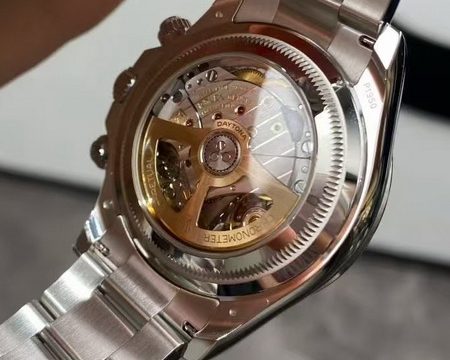
Beyond these unconventional timepieces, many sports or tool watches are not known for high beat frequencies. For example, the Audemars Piguet Royal Oak Offshore runs at 3 Hz. There was a period when Rolex modified the Zenith El Primero movement for use in the Daytona. Back then, both 4 Hz and 5 Hz specifications were available. Rolex ultimately selected the 4 Hz version, and this choice did not stop Rolex watches from achieving outstanding timekeeping precision.

These renowned watchmakers are no amateurs. Facts have long proven that movement quality and the standard of regulation are just as vital to timekeeping precision as beat frequency.
What are the benefits of a high beat frequency?
Naturally, if all other conditions remain identical, a movement with a higher beat frequency theoretically delivers superior timekeeping precision. It is important to note, however, that this comes with trade-offs.

The trade-offs are as follows:
- In most cases, watches with a higher beat frequency are more prone to failure. For example, over one year of use, a 5 Hz watch oscillates 63 million more times than a 4 Hz watch. That extra number of vibrations equals roughly three months of running time for a 4 Hz movement. This generates substantial additional friction, making the movement more susceptible to damage.

Nevertheless, many brands are striving to overcome this challenge, aiming to achieve the best of both worlds. For instance, Breguet Classique Chronométrie 772 adopts an ultra-high beat frequency of 10 Hz. To maintain durability, it employs a silicon escapement and magnetic pivots to cut down friction. Chopard L.U.C 8HF also reaches an ultra-high beat frequency of 8 Hz. Its secret to safeguarding the movement lies in applying silicon to the impulse pallet and escape wheel of the escapement, enabling the movement to better resist wear and tear. It is clear that their shared approach leverages silicon’s properties of wear resistance and light weight to offset the drawbacks brought by high beat frequency.

This point is also easy to understand. A higher beat frequency translates to greater energy consumption, which inevitably shortens the power reserve. You cannot have the best of both worlds.

In summary, for mechanical watches, both high and low beat frequencies come with their own advantages and drawbacks. It is widely accepted today that a beat frequency of 4–5 Hz represents the most balanced option.
Impact on Chronographs
Let’s focus on chronographs. When using a chronograph to measure time intervals, a high beat frequency is essential if you want higher precision in time recording.

The principle is straightforward. Imagine you have two rulers: one marked in 100-centimetre increments and the other in 1000-millimetre increments. Though both rulers have the same total measuring range, readings taken with the latter will obviously be more precise.

The same logic applies to the relationship between chronographs and beat frequency. Virtually all chronographs can measure time in hours, minutes and seconds. However, if you wish to measure time with precision below one second, a higher beat frequency becomes necessary.

For example, a 4 Hz watch oscillates 8 times per second, meaning its readings can be precise to 1/8 of a second. A 5 Hz watch oscillates 10 times per second, delivering precision down to 1/10 of a second. The same logic applies to other beat frequencies. The Jaeger-LeCoultre Duomètre à Chronographe runs at 3 Hz and offers precision to 1/6 of a second, while the Zenith El Primero Striking 10th beats at 5 Hz and can display time to one-tenth of a second. Naturally, this also relies on supporting elements such as dial markings.