During many holidays, plenty of people enjoy going travelling. Adventure‑lovers often head to remote scenic spots where few people venture. In some areas, mobile phone signal is extremely poor. Once deep into these locations, it is easy to get disoriented. Do not panic when this happens. You only need an ordinary analog wristwatch to easily work out directions, provided the sun is visible.




Some may argue that in this internet‑driven era, smartphones have replaced many tools and few people carry wristwatches all the time, so you may not always have one on hand. Besides the watch‑based navigation trick, you can read natural clues around you.
In autumn, if wild geese are visible in the sky, they fly toward the south. You may also observe features on the ground. Ant nests generally face south. Tree rings serve as another reference: wider rings point south while narrower, denser rings face north, because trees grow faster on their southern side. These practical skills are extremely useful outdoors — just in case you get lost.
Method One:
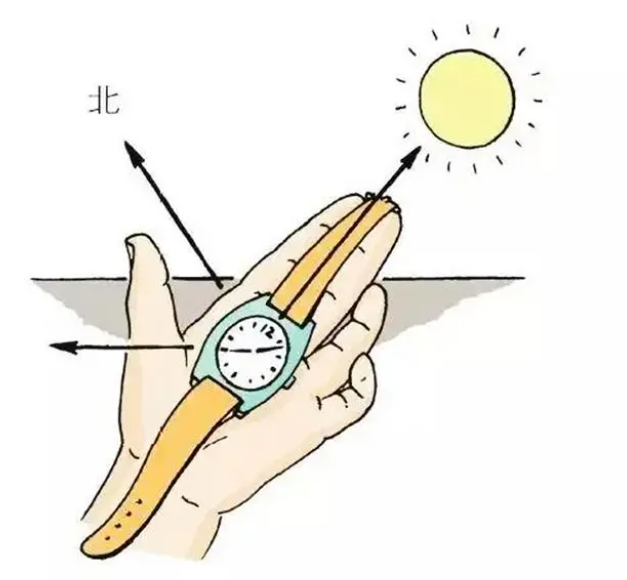
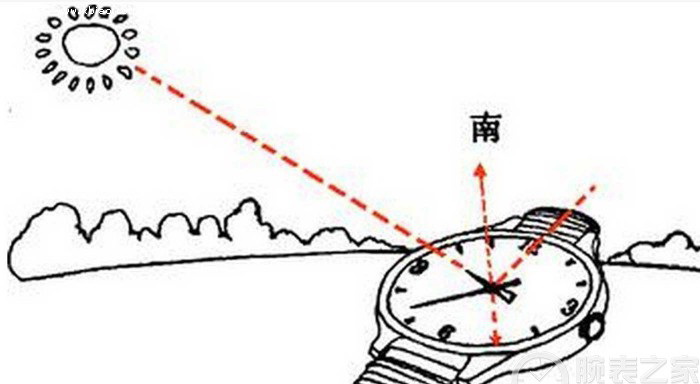
Take out your analog watch and check the current local time. Divide the hour by two. For example, if the result is four, aim the 4‑o’clock position toward the sun. Now check where the 12‑o’clock marker points; that direction is north. You can get your bearing quickly. To sum up: Point the half‑time mark at the sun, and 12 o’clock will indicate true north.
Method Two:
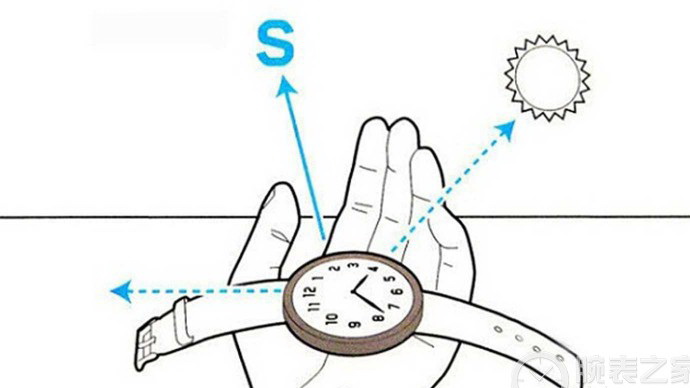
This method is comparatively straightforward. Lay the watch flat regardless of the current hour. Align the hour hand with the sun. The bisector of the angle (the smaller angle less than 180°) formed between the hour hand and the 12‑o’clock marker points due south. This rule works for the Northern Hemisphere and serves as one practical orientation technique if you get lost in the wild.
Method Three:
There is a mnemonic for finding directions with a wristwatch: “Halve the hour, point it at the sun; twelve points toward true north.” Divide the local hour by two, aim the resulting figure on the dial toward the sun, and the 12‑o’clock position will indicate north. Note that afternoon hours must be converted to the 24‑hour format for calculation.
For instance, 4 p.m. becomes 16 in 24‑hour time. Divide 16 by 2 to get 8. Aim the dial’s 8‑o’clock mark at the sun, and 12 o’clock will point north. This formula applies to the Northern Hemisphere; directions are reversed in the Southern Hemisphere.
Winter is arguably the trickiest season for figuring out directions. When snow covers everything in a blanket of white, stay calm. Kneel down and observe how the snow behaves — snow on the southern‑facing side melts faster.
These orientation skills are seldom needed in cities, where street names and landmarks easily tell you where you are. Out in the wilderness, however, they could save your life if you get lost in deserts or forests, making them extremely practical.
All the above‑mentioned rules apply for the Northern Hemisphere. Results will be reversed in the Southern Hemisphere, an important point to bear in mind when navigating with a wristwatch.
Furthermore, most parts of China follow Beijing Time. If you use local time such as Urumqi time for direction‑finding, note there is roughly a two‑hour time difference between Urumqi and Beijing. For greater accuracy, set your watch back by two hours before doing your calculations.