A brand‑new release has arrived from Clean Factory. As most watch enthusiasts know, this manufacturer specialises in Rolex replicas. Its Rolex‑themed releases are usually dependable with few surprises. Since high‑quality two‑tone GMT‑Master II replicas were largely missing from the market, buyers who love the GMT series can grab this model with confidence — and that shows the factory’s strong self‑assurance. Still, let’s take a closer look at the official product description from the manufacturer.
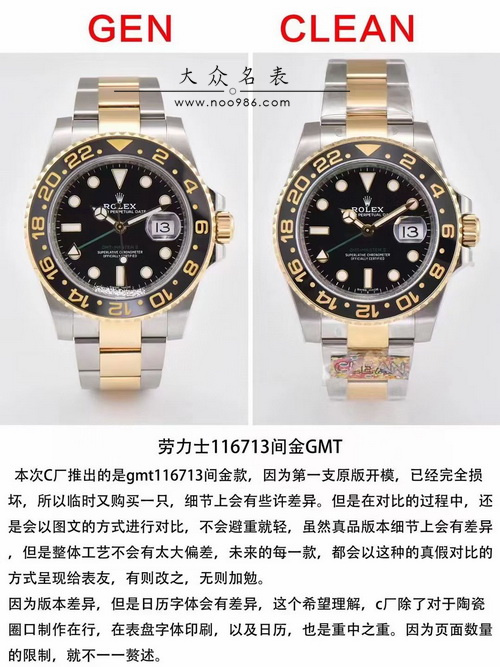
For this launch, Clean Factory has released the GMT‑Master II reference 116713 two‑tone model. The original authentic watch used for the first‑round mould‑making was completely worn‑out and damaged, so a second genuine example was purchased as a temporary replacement. Minor discrepancies in fine details can therefore be expected. Nevertheless, our comparison will be presented with photos and text, without glossing‑over flaws. While slight detail variations stem from using two different genuine samples, the overall craftsmanship remains largely consistent. Going forward, every new model will be shared with watch enthusiasts through this kind of replica‑versus‑genuine review. Any defects will be corrected, and existing strengths will be further improved. Please note that calendar font differences may appear due to the change‑over of reference watches. Apart from its well‑known expertise in ceramic bezel production, Clean Factory also places high priority on dial‑font printing and calendar‑window finishing. For the sake of page length, we will not go into every single detail one‑by‑one.
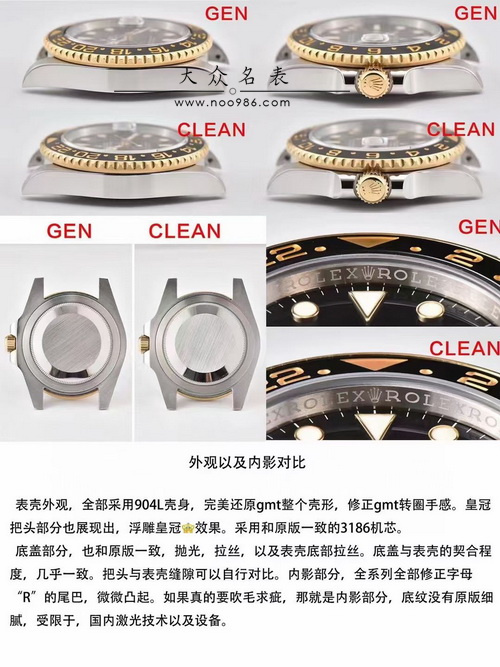
The entire case is crafted from 904L steel, faithfully reproducing the full case profile of the GMT‑Master II. The rotating‑bezel action has been revised for an improved turning feel, and the embossed crown logo on the winding crown is well rendered. It is fitted with a 3186 movement identical to that of the genuine watch. The case‑back features the same polishing and brushed finishing as the original, including brushed texture on the underside of the case. The fit between case‑back and watch case is nearly identical to the factory original. You may compare the gap between the crown and the case for yourself. For the inner‑engraved bezel, the tail of the letter “R” has been slightly raised and corrected across the whole series. If one were to nitpick, the background texture on the inner‑bezel engraving is not quite as fine as on the authentic watch, a limitation caused by domestic laser‑engraving technology and equipment.
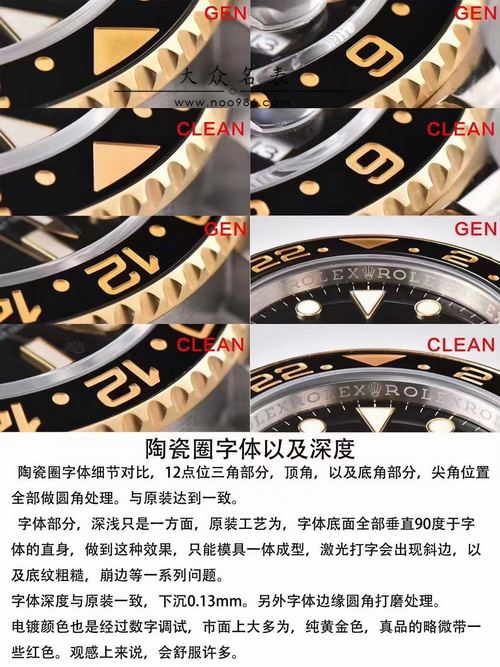
Fonts and engraving depth of the ceramic bezel
For the detail comparison of the lettering on the ceramic bezel, the top corner and bottom‑tip corner of the triangle marker at the 12‑o’clock position have all been rounded, consistent with the genuine watch.
Engraving depth is only one aspect of the font work. The original‑factory craftsmanship features font bases perfectly perpendicular at 90° to the font side walls. This result can only be achieved by one‑piece mould forming. Laser engraving will lead to slanted sides, rough base texture, chipped edges and other defects.
The engraving depth of the characters matches the original with a recess of 0.13 mm. Moreover, the edges of the lettering are polished with rounded‑corner finishing.
The electroplated colour has been digitally calibrated. Most items available on the market show a pure golden tone, whereas the genuine watch carries a faint reddish undertone for a much‑softer visual glow.
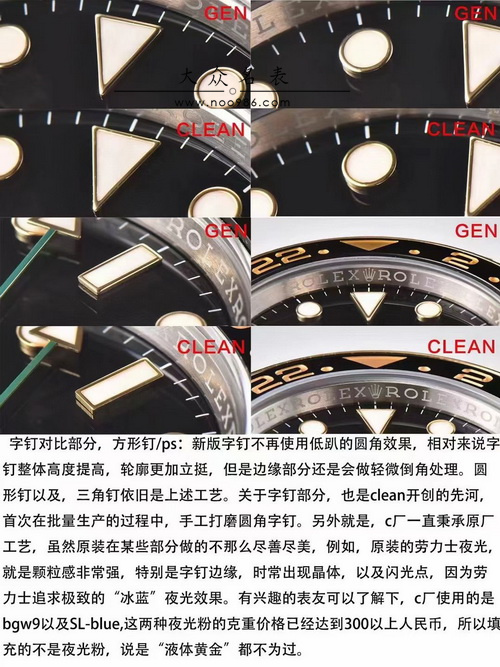
Index Marker Comparison. Square markers‑ Note: The new‑version markers no longer feature the low‑profile rounded‑edge finish. Instead, the overall height of the markers has been increased for a sharper, more upright profile, while light chamfering is still applied to their edges. Circular and triangular markers follow the craftsmanship described above.
Clean Factory pioneered this approach, being the first manufacturer to hand‑polish rounded‑edge markers during mass‑production. Furthermore, Clean consistently adheres to original‑factory standards, even when certain details on genuine watches are imperfect. For instance, genuine Rolex lume exhibits a strong grainy texture, especially along marker edges where crystal specks and bright flecks frequently appear, as Rolex prioritises the iconic icy‑blue luminous effect. Watch enthusiasts who wish to learn more should note that Clean uses BGW9 and SL‑Blue luminous pigments. These luminescent powders cost over 300 RMB per gram, making the luminous fill worthy of the nickname “liquid gold”.
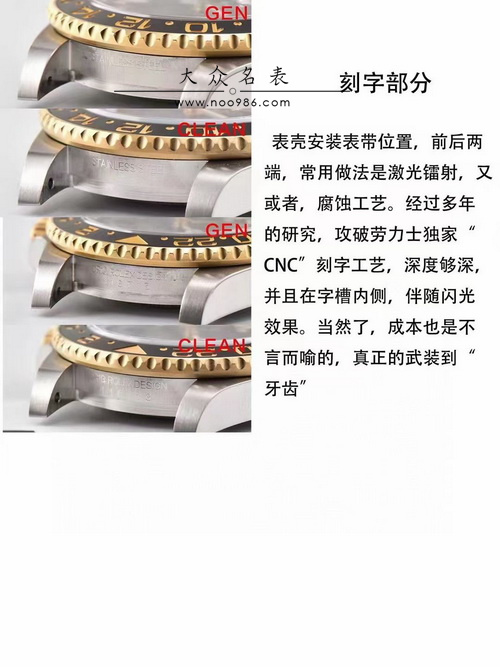
Engraving Section
At the front and rear lug positions where the bracelet attaches to the case, laser engraving or acid‑etching techniques are commonly used. After years of research, we have cracked Rolex’s exclusive CNC engraving process. The engraving reaches a sufficient depth, and the inner walls of the engraved grooves deliver a sparkling finish. Naturally, the production cost is self‑explanatory, with meticulous attention paid down to the finest details.
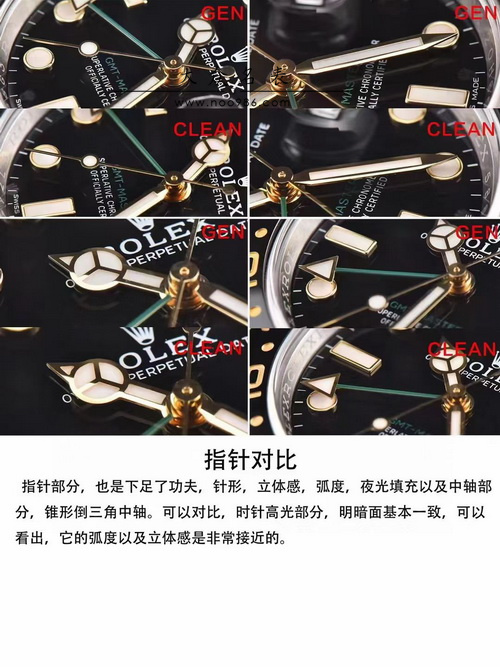
Hands Comparison
Great effort has been devoted to the watch‑hands. This covers hand shape, three‑dimensional depth, curvature, luminous filling and the central spindle with its tapered triangular arbor. You may compare the highlight area on the hour hand; its light‑and‑shade planes are nearly identical to the original, demonstrating that its curvature and three‑dimensional effect are extremely close to those of the genuine watch.
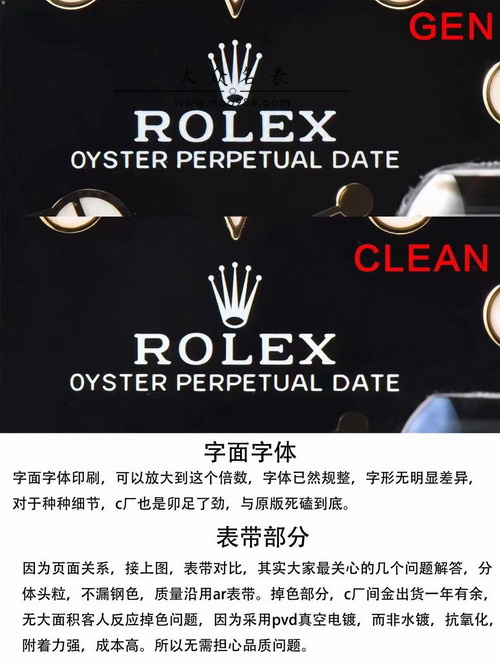
Dial Printing
When magnified to this scale, the printed characters are neat with no obvious differences in font shape. Clean Factory has spared no effort to match every fine detail of the original dial.
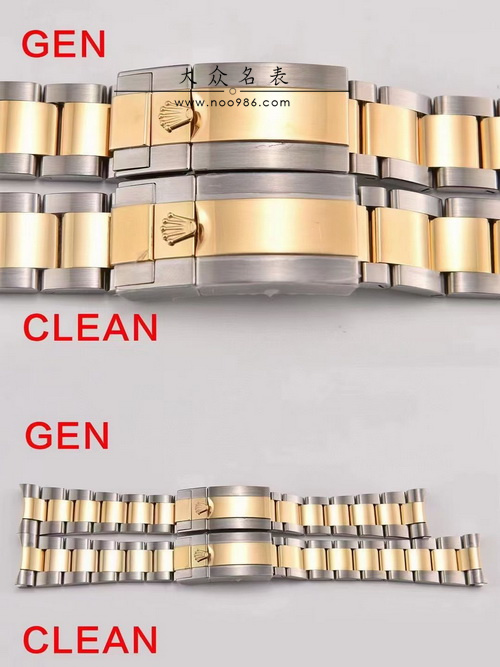
Moving on to the bracelet comparison (continued from the previous image due to page limits), here are answers to the most‑frequently‑asked questions. It features split end‑links with no exposed bare steel. The bracelet uses the proven build quality of AR‑grade bracelets.
Over one year since the two‑tone model was released, there have been almost no customer reports of widespread fading. A PVD vacuum‑plating process, rather than wet electroplating, is adopted. This provides strong oxidation resistance and high coating adhesion at a higher production cost, so you can rest assured of its quality.
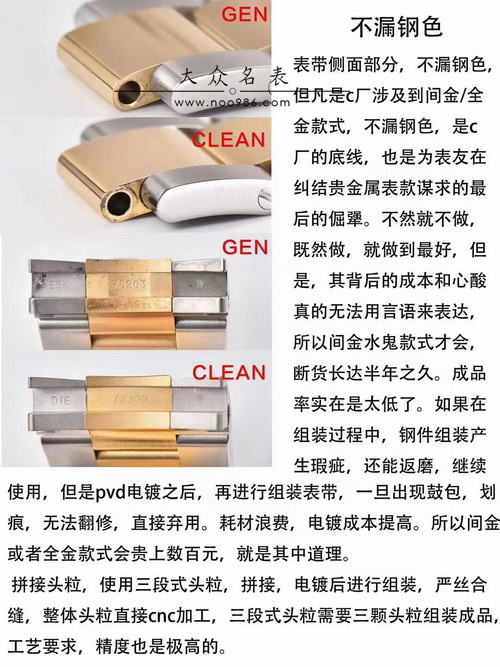
No exposed bare‑steel areas. The sides of the bracelet show no bare steel. For every two‑tone or full‑gold model produced by Clean Factory, zero exposed bare steel is a non‑negotiable baseline standard. This represents our final commitment to watch‑lovers shopping for precious‑metal‑style timepieces. If we could not deliver this standard, we would not launch the model at all; once we commit to production, we aim for perfection. However, the costs and production hardships behind this goal are difficult to put into words, which explains why the two‑tone Submariner was out of stock for as long as six months. The finished‑product yield rate is extremely low.
If steel parts sustain minor defects during assembly, they can be sent back for re‑polishing and reused. Yet once the bracelet has received its PVD coating, any bubbles or scratches that appear during assembly render the part irreparable, and it must be discarded entirely. This generates high material waste and raises electroplating expenses. This is the reason two‑tone and full‑gold models cost several hundred units more.
Three‑piece split end‑links are adopted. Components are assembled after electroplating for a seamless, tight‑fitting finish. Unlike one‑piece CNC‑machined end‑links, the three‑segment design requires three separate pieces to be joined together, demanding extremely high‑precision manufacturing standards.