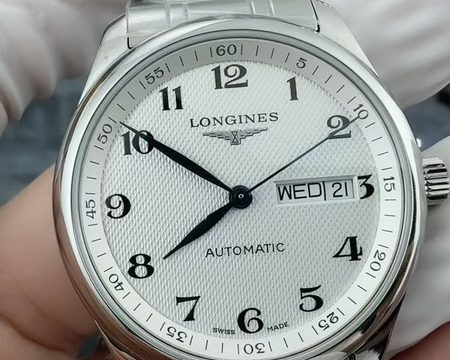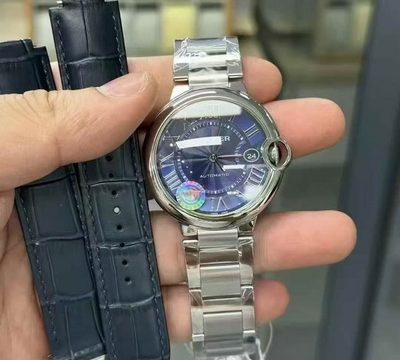

- Which direction should the hands turn when setting the time on a watch? A. Turn the hands clockwise B. Turn the hands counterclockwise C. No rules; adjust in any direction you prefer
The Correct Answer There have long been two schools of thought on this question. Most people believe time must be set clockwise; if the watch runs fast, you should stop the seconds hand to synchronize the time. A minority hold the opposite view, claiming time should be set counterclockwise to eliminate backlash between gears. The widely held belief of clockwise-only adjustment stems mainly from two reasons:
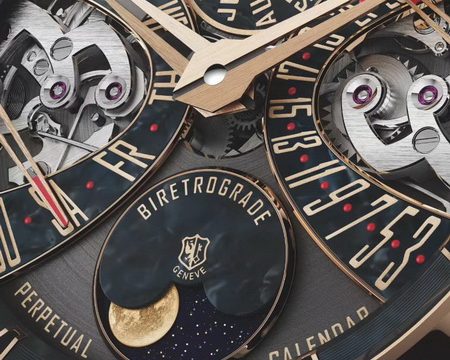
- For movements with additional complications, turning the hands counterclockwise may damage these supplementary mechanisms, which are often fragile, especially during the time window when the complication is active. Such complications include, but are not limited to, date, day, moon phase and annual calendar displays.
- Some vintage or special movements are engineered to discourage counterclockwise hand adjustment. Forcing the hands backward creates significant extra resistance and may cause component damage in severe cases.

- What is the danger zone for setting a watch’s date? A. 9 p.m. to 3 a.m. B. 9 p.m. to 3 a.m. plus 9 a.m. to 3 p.m. C. There is no such danger zone
The Correct Answer First, it helps to understand where the 9 p.m. to 3 a.m. rule originates (some sources cite 8 p.m. to 4 a.m. instead). This rule applies primarily to movements with slow-changing date displays. Simply put, slowly creeping date mechanisms have an active working window. Depending on individual watch designs, the date disc enters its changeover phase starting at a certain time in the evening. This process can last 2 to 4 hours and concludes in the early hours of the morning. The exact start and end times vary between models, but the 9 p.m.–3 a.m. window covers nearly all watches.
Option B adds the 9 a.m. to 3 p.m. period. This accounts for newly acquired watches or watches that have stopped for a long time, which may be off by 12 hours. If you attempt to set the date at 10 a.m., internally the watch may actually read 9 p.m., meaning the date disc has already begun its switching cycle.

- Which shock absorber is better: the triangular shock absorber or Incabloc? A. Triangular shock absorber B. Incabloc shock absorber C. Each has its strengths
The Correct Answer First, it is worth noting that the triangular shock absorber is also manufactured by Incabloc SA. Some watch enthusiasts group the triangular type under Incabloc and then differentiate between the “triangular flower” and “horseshoe” variants, or refer to them as “triangular Incabloc” and “standard Incabloc”. This classification is unnecessary. The shock absorber bearing the Incabloc brand name is the horseshoe-shaped model, trademarked as Incabloc. The triangular shock absorber carries a separate trademark, Novodiac. As an analogy, Qoo is produced by The Coca-Cola Company but has its own independent trademark.
Second, there is a price difference between the two. The triangular shock absorber is indeed cheaper than the Incabloc. This conclusion comes from my research on overseas pricing. At the same quality tier, the Novodiac triangular shock absorber costs roughly one-third of the price of an Incabloc shock absorber. (Note: Multiple references show shock absorbers are available in several quality grades.)

- Is the KIF shock absorber necessarily better than Incabloc? A. Yes B. No C. Hard to tell
The Correct Answer Briefly, this is a piece of watchmaking history. Back in the 1950s, Incabloc dominated the exclusive market for movement shock absorbers and wielded huge influence within the watch industry. It even required watchmakers to print the “Incabloc” logo on watch dials. This demand triggered the strongest pushback from Rolex. Rolex then made the decision to switch its entire watch lineup to KIF, its rising competitor. KIF gradually built a solid reputation, and many local watch manufacturers followed suit, including high-end maisons such as Audemars Piguet, Breguet and Jaeger-LeCoultre. That is why many watch enthusiasts assume KIF ranks higher than Incabloc. In truth, this was merely a historical coincidence.

- Is an original leather watch strap always the best option? A. Yes B. No C. Hard to tell
The Correct Answer For most luxury watch brands, factory-original leather straps are indeed top-tier. Crafted from American alligator leather by hand, they deliver reliable premium quality. However, leather straps are consumable items, and OEM straps come with steep price tags. For this reason, even owners of high-end watches often opt for affordable aftermarket leather straps as spares.
For mid-range and entry-level brands, factory straps are not necessarily superior. Many accessible brands fit their watches with cowhide straps simply embossed with alligator grain patterns. From my observations, these cowhide straps often fail to outperform aftermarket options such as Hirsch, JORI or TK (purchased online) in terms of realistic alligator texture and construction durability.
- Can I get a free watch service during the warranty period? A. Free maintenance available B. Service available at owner’s expense C. No maintenance if no defects are found
The Correct Answer For an authoritative answer, you need to check directly with the official service center, as policies vary between brands and product tiers. None of the three options above fully describes the rule. The real rule: servicing including repairs, part replacement, cleaning and water-resistance testing is free only when a manufacturing defect occurs. If the watch works properly without faults, routine maintenance is chargeable.

The Correct Answer Not only Hong Kong-sourced genuine watches, any authentic timepiece purchased worldwide qualifies for international warranty service in mainland China. Then why do many watch owners complain their Hong Kong-bought watches get rejected for mainland warranty, claiming the 2-year global warranty is a scam? The simple reason: they brought their watch to a retail boutique counter.
It is critical to distinguish between retail boutiques and official service centers. Boutiques are authorized dealers with an agency agreement with watch manufacturers, rather than being directly affiliated subsidiaries. Take Tissot under the Swatch Group as an example. Its retail boutiques are licensed resellers, not internal departments of Swatch Group, so they bear no obligation to perform watch repairs. If you bought your watch at that boutique, they may forward it for repair out of customer service. If not purchased from their store, they will usually decline assistance.
Official service centers, either brand-operated or authorized third-party facilities, are obligated to repair watches covered under active warranty. Generally, there are far more authorized retail boutiques than official service centers.
- Will frequent manual winding harm an automatic watch? A. Yes B. No C. Hard to tell
The Correct Answer The answer is C. This may surprise those who picked A or B. Simply put, whether damage occurs depends on the design of your automatic mechanical movement for manual winding.
Generally speaking, manual winding will not damage the movement. For one thing, manual winding is a built-in basic function of automatic watches. For another, if manual winding caused damage, manually-wound watches would not exist.
Bear in mind, however, that mechanical wear is inevitable whenever a mechanical watch is running. Rotation of the automatic rotor for self-winding creates wear; manual winding creates wear as well. When you manually top up power due to insufficient wrist movement, you shift wear away from the rotor and reverser wheels onto the crown, stem and winding wheels. The only extra wear outside the movement occurs on the crown’s gasket.

One last point to emphasize: some watch enthusiasts believe manual winding conflicts with the self-winding system and that frequent manual winding damages the automatic winding assembly. This idea holds partial truth, mainly for certain movements with inherent design flaws in their automatic winding systems, yet it does not apply universally. For the vast majority of modern automatic movements, manually topping up power to compensate for insufficient wrist activity causes no harm to the movement itself. You can also wind the watch by gently shaking it, and perform manual winding when needed.
- Can quartz watches be magnetized? A. Yes B. No C. Not sure
The Correct Answer Quartz watches are not immune to magnetism.
- LCD quartz watches and inexpensive quartz timepieces with nearly no metal components are largely unaffected by magnetization, except under extremely strong magnetic fields.
- Ordinary quartz watches can still become magnetized, though they offer better resistance to magnetism compared with mechanical watches. As a general guideline for standard watch anti-magnetic performance, keep the watch at least 5–10 centimetres away from strong magnetic objects such as mobile phones and speakers to avoid major issues.